
Collagen Connective Tissue Disorders
What is a Collagen Connective Tissue Disorder?
Collagen gives strength and cohesion to bones, joints, muscles, blood vessels and skin, among other things. In Collagen Connective Tissue Disorders this connective tissue works differently. The consequences can therefore affect the whole body.
Collagen is the rope that holds your body together
Collagen is a protein that runs through your whole body as strong, interwoven fibres: in bones, muscles, skin, tendons and blood vessels.
In a CBA the body produces this protein incorrectly. The fibres are thinner, weaker or wrongly built — so the “rope” frays and the body loses its strength.
Strong collagen
fibres grip each other firmly
Weak collagen
fibres fray and break
This affects us
Behind every number is someone who lives with the consequences of weak collagen every day. This is how the symptoms are distributed:
30.000+
people in the Netherlands live with a CBA
23.000+
live with painful muscles
4.500+
have fragile blood vessels
4 in 10
are estimated to depend on a wheelchair
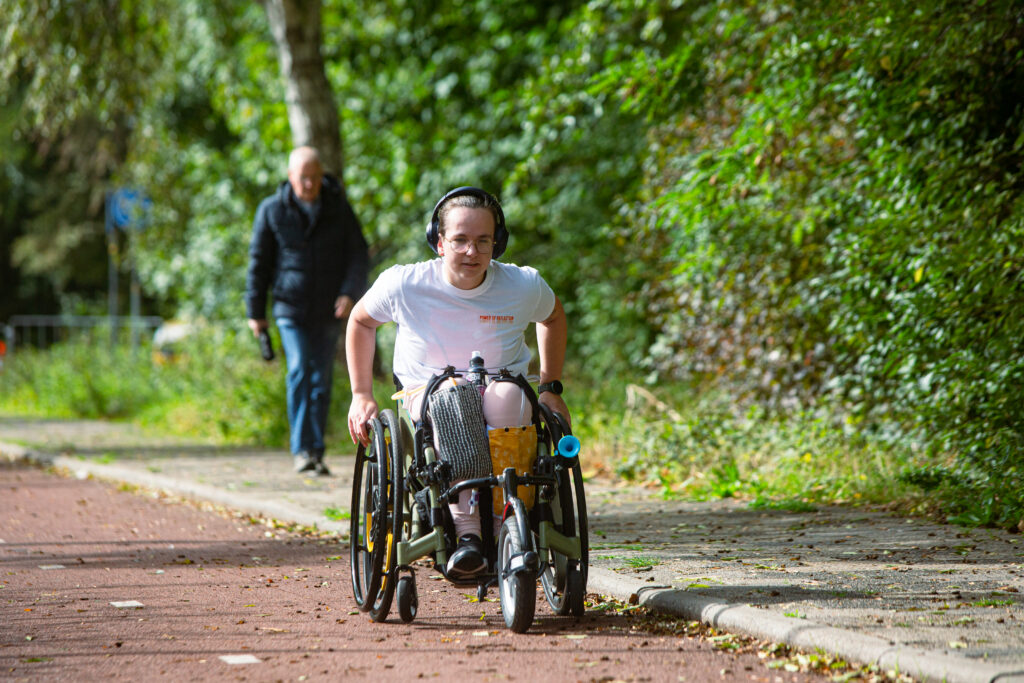
Around 4 in 10 depend on a wheelchair
Around 40% of people with a CBA depend on a wheelchair. That is why, alongside our research into medication, we work with Freedom on Wheels towards a more wheelchair-accessible Netherlands.
Why are there so many disorders?
Collagen connective tissue is found throughout the body and comes in different types. Six hereditary collagen types can cause serious connective tissue disorders. Depending on which type is affected, a different clinical picture arises, with life-defining consequences.
- Osteogenesis Imperfecta
- Ehlers-Danlos syndrome
- Marfan syndrome
- Loeys-Dietz syndrome
- Stickler syndrome
- Alport syndrome
- Bruck syndrome
- Collagen VI-related disorders
- Other inherited collagen and connective tissue disorders
Rare, but numerous together
Each condition is rare on its own. Together, they affect more than 30,000 people. By sharing knowledge and exploring common underlying mechanisms, we aim to accelerate research, improve recognition and advance treatment.
±1
in
600
About 1 in 600 people in the Netherlands lives with a Collagen Connective Tissue Disorder. There is no cure yet.
We believe in connection: by coming together, we can learn from the important similarities in connective tissue and the biological mechanisms involved.
Research & Development
We bring people, knowledge and research together to speed up the road to effective treatments and to improve quality of life.
Effective medication
Research into ways to cure CBA, from fundamental research to clinical application.
Anxiety- and pain-free treatment
Treatments that minimise traumatic experiences and improve quality of life.
Wheelchair accessibility
With Freedom on Wheels we work towards a more accessible Netherlands.
There is no cure yet. Not yet.
Your support brings research into a cure closer.